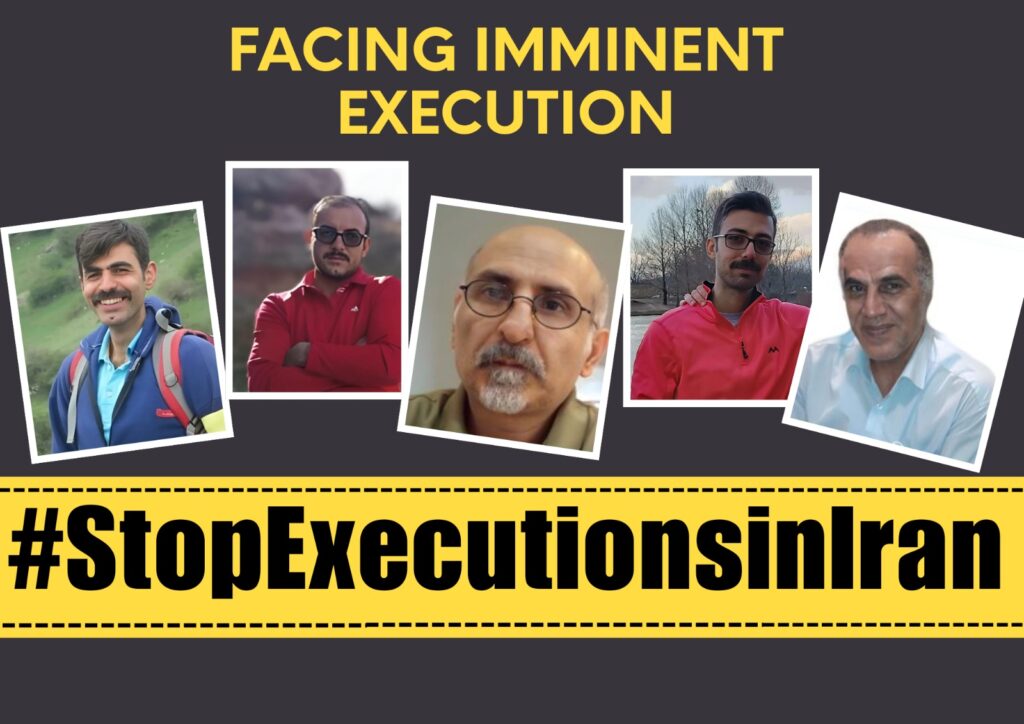
London, 8 August 2025: Justice for the Victims of the 1988 Massacre in Iran (JVMI) is alarmed by credible reports that five Iranian political prisoners have been violently transferred this morning from Fashafooyeh Prison in Tehran to Ghezel Hesar Prison in Karaj, a facility frequently used for carrying out political executions. According to information relayed by phone from Evin Prison, other political detainees in Fashafooyeh were moved to Evin while these five—all on death row—were taken to Ghezel Hesar. This pattern is a well-known precursor to execution, and we fear their executions may be imminent.
The prisoners at risk
- Vahid Bani Amerian (33) — Management graduate; repeatedly arrested since 2017.
- Seyed Mohammad Taghavi Sangdehi (59) — Political prisoner since the 1980s–1990s; further imprisonment and torture reported.
- Akbar (Shahrokh) Daneshvar Kar (58) — Civil engineer; arrested January 2024.
- Babak Alipour (34) — Law graduate; multiple detentions, most recently January 2024.
- Pouya Ghobadi Basetouni (33) — Electrical engineer; arrested March 2024 with prior detentions.
All five, along with a sixth co-defendant, Abolhassan Montazer (66)—an architect and long-time political prisoner with severe health conditions—were sentenced to death on 25 November 2024 by Judge Iman Afshari of Branch 26 of the Tehran Revolutionary Court.
Grave fair trial concerns and international law
The charges in this case—including “baghi” (armed rebellion against the government) through “membership in the People’s Mojahedin Organisation of Iran (PMOI or MEK),” and “conspiracy against national security”—appear to be politically motivated and raise serious concerns of criminalising peaceful association and dissent. Imposing the death penalty following proceedings that fail to meet international standards of fairness contravenes Iran’s obligations under the International Covenant on Civil and Political Rights (ICCPR), including the rights to life and to a fair trial and the prohibition of torture or ill-treatment.
A pattern of escalated risk
The transfers come less than two weeks after political prisoners Behrouz Ehsani and Mehdi Hassani were executed in Ghezel Hesar on similar charges tied to PMOI membership, despite international appeals.
Those executions followed a 7 July 2025 editorial by Fars News Agency—affiliated with the Islamic Revolutionary Guard Corps (IRGC)—which described the 1988 mass executions as a “successful historical experience” and explicitly called for their repetition against current political opponents.
The editorial, entitled “Why the 1988 Executions Should Be Repeated,” not only justifies and glorifies crimes against humanity, but also issues what can only be interpreted as incitement to commit future atrocity crimes. It seeks to normalise the extrajudicial killing of political opponents by framing them as threats to national security, aligning with a broader pattern of state-sponsored dehumanisation and criminalisation of dissent.
JVMI previously warned that the publication of such content by a media organ directly affiliated with the IRGC—an entity sanctioned internationally for grave human rights violations—underscores the urgent risk of recurrence of mass atrocity crimes in Iran.
In recent weeks, numerous other political prisoners have been sentenced to death on similar charges, while many opposition activists, former political prisoners, and relatives of dissidents have been summarily arrested in a coordinated manner.
In his 2024 landmark report on atrocity crimes, the then-United Nations Special Rapporteur on the situation of human rights in the Islamic Republic of Iran, Professor Javaid Rehman, concluded that the events of 1988 “amounted to the crimes against humanity of murder, extermination, persecution, and other inhumane acts.”
The report further noted that “there is considerable evidence that mass killings…were conducted with genocidal intent.” His report called for international accountability and noted the systematic impunity that has emboldened Iranian authorities to continue committing gross human rights violations, including the recent unlawful executions of protesters and prisoners of conscience.
JVMI condemns the recent political executions, death sentences, arrests and incitement to repeat the 1988 massacre in the strongest terms.
JVMI repeats its request to the Office of the High Commissioner for Human Rights (OHCHR), the Independent International Fact-Finding Mission on Iran (FFMI), the UN Special Rapporteur on the situation of human rights in Iran and her colleagues in the Special Procedures, as well as governments worldwide, to publicly call for an immediate halt to these political executions and to press for compliance with Iran’s international human rights obligations. Silence now would be a green light for further irreversible violations. The lives of Iran’s political prisoners depend on swift, public, and coordinated action.
***
Background to the 1988 Massacre:
In 1988, the government of Iran massacred an estimated 30,000 political and ideological prisoners. The extrajudicial executions and enforced disappearances took place based on a fatwa by then-Supreme Leader Ayatollah Ruhollah Khomeini, targeting the main opposition movement, the People’s Mojahedin Organisation of Iran (PMOI or MEK). Three-member commissions known as ‘Death Commissions’ were formed across Iran, sending political prisoners who refused to abandon their beliefs to execution. Members of other leftist groups were also executed in a subsequent second wave. The victims were buried in secret mass graves. The perpetrators continue to enjoy impunity.
Contact:
Justice for the Victims of the 1988 Massacre in Iran (JVMI)
Email: [email protected]
Website: www.iran1988.org