London, 16 August 2025 – Justice for the Victims of the 1988 Massacre in Iran (JVMI) expresses grave concern over the recent destruction of Section 41 of Behesht Zahra Cemetery in Tehran. On 11 August 2025, Iranian authorities, deployed bulldozers, heavy machinery, and security personnel to flatten one of the most historically significant burial areas for political prisoners executed during the 1980s.
This act represents a deliberate attempt to eliminate physical evidence of serious human rights violations and to obstruct efforts to secure truth and accountability. JVMI condemns this action and calls for urgent international intervention to prevent further destruction and to uphold the rights of victims’ families.
Section 41 of Behesht Zahra Cemetery contains thousands of individual graves of political prisoners executed throughout the 1980s, with a particular concentration from 1981—a year marked by mass arrests and summary executions of dissidents. Many of those buried in this section were affiliated with the People’s Mojahedin Organisation of Iran (PMOI/MEK), as well as other opposition groups targeted by the authorities. The section is estimated to have a capacity of 9,500 graves.
Section 41 remains a critical site of collective memory for families of those executed across the decade. Since the early 1980s, Iranian authorities have maintained strict control over the area, routinely harassing families, defacing gravestones, and restricting access. The site has become emblematic of both the scale of political repression and the ongoing efforts to suppress public remembrance.
Timeline of Destruction
The destruction of Section 41 has taken place incrementally over several decades:
- 1980s–1990s: Gravestones were broken, inscriptions obscured, and families subjected to surveillance and intimidation.
- 2005–2007: Approximately 3,500 square metres of Section 41 were converted into a car park.
- 2003–2017: Authorities allowed the site to deteriorate, accelerating its physical decay.
- April 2021: Similar destruction was reported in Khavaran Cemetery, raising concerns about the future of Section 41.
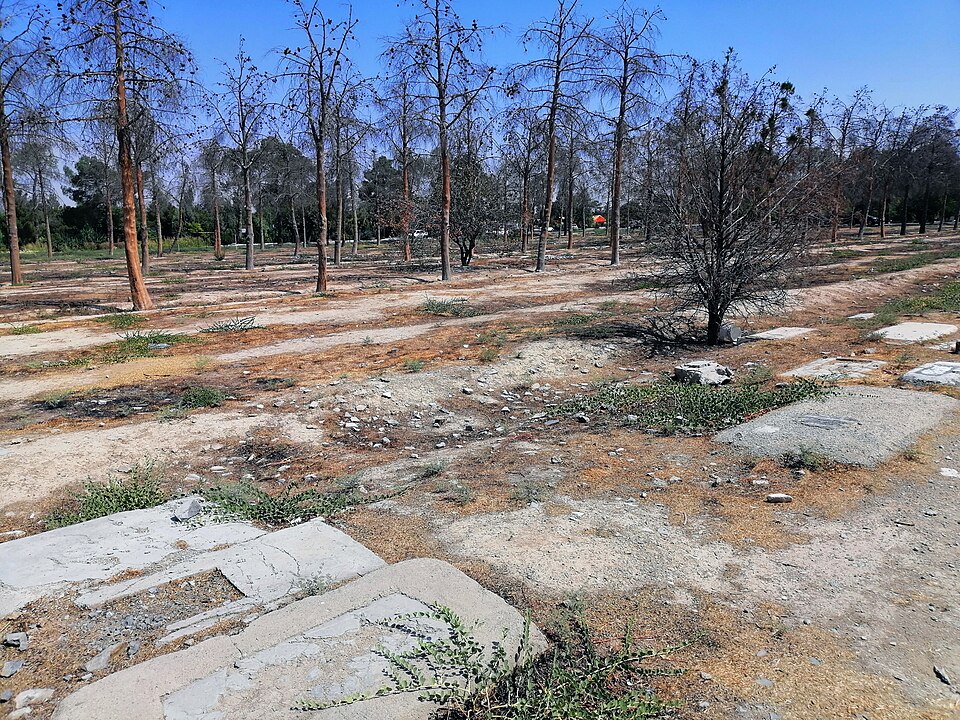
- 11 August 2025: Bulldozers flattened Section 41 under armed guard. Trees were cut down, vegetation burned, and the area sealed off from public access.
This latest incident is not an isolated event but part of a sustained policy of erasure.
Methods of Erasure
The destruction of Section 41 has been carried out through a range of deliberate and coordinated measures. Gravestones have been removed or smashed, and inscriptions have been obscured using tar and paint. Bulldozers have been used to level the terrain, with parts of the land repurposed for non-memorial use, including car parks. Authorities have also burned vegetation, cut down trees, and installed a permanent security presence to prevent families from gathering or commemorating their loved ones. These actions are designed not only to eliminate physical traces of political executions but also to suppress public memory and obstruct mourning.
UN Documentation and Expert Findings
Professor Javaid Rehman, former United Nations Special Rapporteur on the situation of human rights in the Islamic Republic of Iran, has repeatedly raised concerns about the systematic destruction of burial sites. In his landmark Atrocity Crimes report in July 2024, the Special Rapporteur described the 1988 executions as “ongoing crimes against humanity” and “genocide”. He called for the application of universal jurisdiction to prosecute those responsible.
Professor Rehman’s reports have documented the destruction of grave sites in both Section 41 of Behesht Zahra Cemetery and Khavaran Cemetery.
Need for Accountability
JVMI views the destruction of Section 41 as a calculated assault on truth, memory, and justice. We stand in solidarity with the families of the victims and reaffirm our commitment to securing accountability for the mass executions of the 1980s.
We urge the Office of the High Commissioner for Human Rights (OHCHR), in conjunction with the current UN Special Rapporteur on Iran, Dr. Mai Sato, and members of the Independent International Fact-Finding Mission on the Islamic Republic of Iran (FFMI), to launch an independent investigation into the destruction of Section 41 and other burial sites.
We further urge the UN and its Member States to demand an immediate halt to all demolitions of graveyards where political prisoners are buried and guarantee unrestricted access for families.
The government of Iran must be held accountable for its actions. The international community has a moral and legal obligation to stop Iran erasing evidence of its atrocity crimes. It must ensure that the memory of the victims is preserved, and that justice is not denied.