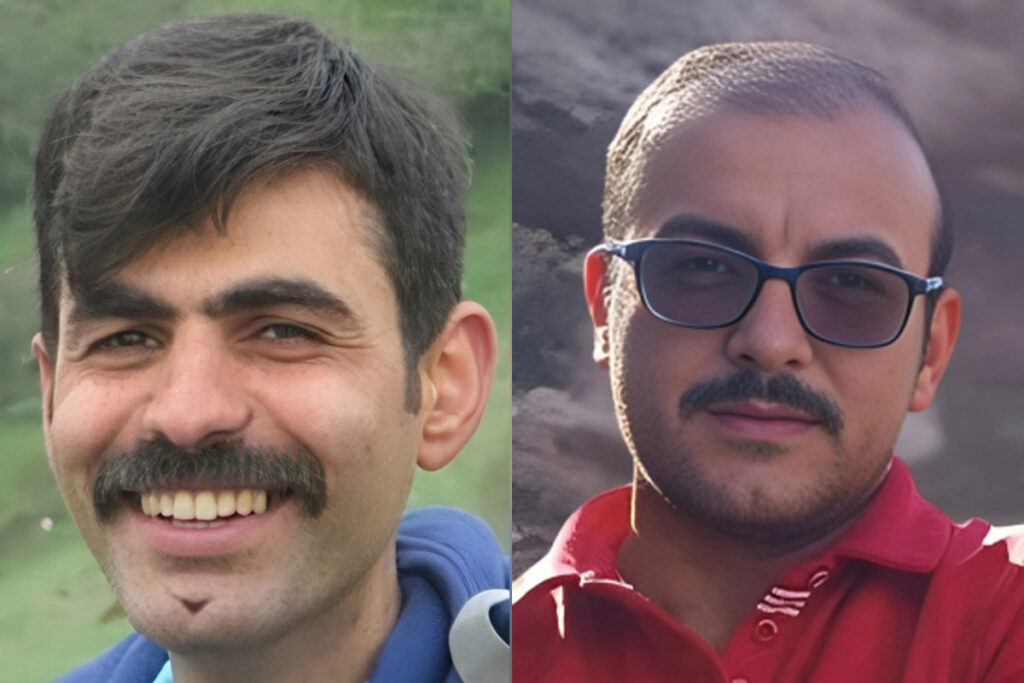
London, 31 March 2026: Iranian authorities executed two more political prisoners on Tuesday for membership in the opposition People’s Mojahedin Organisation of Iran (PMOI or MEK) and for “attempting to overthrow the Islamic Republic”, one day after hanging two others from the same group.
Babak Alipour, 34, and Pouya Ghobadi, 32, were hanged this morning, according to the state-run Tasnim News Agency. This follows the executions yesterday morning of Akbar Daneshvarkar, 59, and Seyed Mohammad Taghavi‑Sangdehi, 58, on identical charges.
The four men were part of a group of six political prisoners charged with “membership in the PMOI”, “assembly and collusion to commit crimes against internal and external security”, “armed rebellion (baghi) against the Islamic government”, and “formation of a group to disrupt national security”.
Alipour, a law student from the city of Amol, was arrested in Tehran on 27 December 2023. Ghobadi, an electrical engineer from the city of Sonqor, was arrested in the Chaldoran border on 23 February 2024 as he attempted to leave Iran.
All six were sentenced to death on 30 November 2024 by Judge Iman Afshari of Branch 26 of the Tehran Revolutionary Court. The trial, held on 6 October 2024, lasted only a few minutes. The charge of “armed rebellion” (baghi) was based solely on the men’s alleged affiliation with the PMOI, with no evidence of involvement in violence presented.
In August 2025, the six prisoners were transferred to Qezel Hesar Prison — a facility notorious for carrying out political executions — raising serious concerns about their imminent execution.
The prisoners were subjected to severe physical and psychological torture, including beatings, threats of summary execution, and prolonged solitary confinement.
Babak Paknia, the defence lawyer for Alipour, Ghobadi and a third defendant, announced in a tweet on 30 March 2026 that he had received no formal notification from the judiciary about his clients’ fate.
Justice for the Victims of the 1988 Massacre in Iran (JVMI) had previously submitted case files concerning Babak Alipour and Pouya Ghobadi to the UN Special Rapporteur on the situation of human rights in Iran on 10 August 2025, and had raised concerns regarding the entire group.
In part of his testimony to the Special Rapporteur, submitted on his behalf by the JVMI, Alipour states:
“From the very first moment of my arrest, they attacked me from behind while I was walking on the sidewalk of Enqelab Street. One person grabbed my hand and twisted it, another swept my legs from under me, and I fell hard to the ground along with the food items I was carrying. I hit the ground so forcefully that my right elbow and back hurt for 20 days. More than 10 people surrounded me. One of them, the senior member of the Ministry of Intelligence’s operations team—who weighed around 130 kilos—sat on me. They handcuffed me and sat me on the side of the street to wait for the vehicle that would transfer me.
Someone came up from behind and whispered in my ear: “Your crime is serious—cooperate or you’ll be executed.” Right there on the street, they carried out a body search, focusing on finding a firearm, although there was absolutely no basis for that. All I had with me was bread, cheese, dates, and a couple of flasks of tea, all inside a light-coloured plastic bag.
A Renault Duster SUV arrived. Someone got out from the back seat and, in a harsh tone, said: “Get in.” He shoved me angrily into the car, got in himself, slammed the door, jabbed his elbow into my side, and with insults asked, “What have you done?” I said, “I haven’t done anything.” He swore at me and said, “Shut up, don’t lie.” On the way to the destination, he kept punching me and hurling insults.
The head of the operations team turned on his phone camera and said: “You have to speak in front of the camera and introduce yourself.” I refused. They began beating me to force me to speak on camera. One person held my cuffed hands, another pushed me into the corner, and their team leader slapped me across the face, struck me with the back of his hand, punched me in the back of the head, and punched me with his fists and knees in my stomach and testicles.
When I arrived at the “Follow-up Office” on Vali Asr Street, I was blindfolded and didn’t know where I was being taken or which agency it was. The interrogator — a young man around 30 or 35 years old — told me to get up from the chair, face the wall, and press my head against it. He left, then came back five minutes later. My head had moved slightly away from the wall. He shouted: “Didn’t I tell you to press your head against the wall?” Then he said: “Do you know where you are? This is the Ministry of Intelligence, the most secure place in Iran.”
After a few minutes, another interrogator joined in, who was older than the first interrogator. There were a few other people around and behind me. They started with psychological and emotional torture in order to influence me with my feelings and emotions towards my family members. They said, “Don’t you feel sorry for your parents? Are they alive? How old are they? Don’t they want you to be with them? Why should they tolerate your absence? Do you have a brother? Don’t you love your brother?” And then they came in through enticement that if you cooperate, we will give you a decent job with a high income, a car, a house, and benefits, and then they said that if you do not cooperate, we will give you a long prison term. After this stage of psychological and emotional pressure, enticement, and threats of a heavy sentence, another person entered the room. They introduced him as the Deputy Prosecutor. He said: “The lads have told me you have not cooperated with them. Do you know that if you do not cooperate, the sentence issued for you will be execution, and it will be carried out in less than a year?”
After that, the second interrogator began to humiliate and provoke me so that I would react and say something they could record and use as evidence against me in court. He went on to insult and swear at me and at my family members — my father, my mother, and my sister — and began physically assaulting me. He punched me in the head and face. As a result of these blows, the skin under my right eye was grazed, my right ear was injured, and I had pain and swelling from my forehead to the back of my head, to the point that for several days I could not rest my head on a pillow.
He said: “You must speak and confirm the accusations we are making against you, otherwise I will keep beating you until morning.” Then, using a pistol, he threatened to kill me, saying: “Will you talk, or shall I kill you?” He came close, forced the barrel of the gun into my mouth, and repeated: “Talk, or I will kill you.”
All of this humiliation, verbal abuse, swearing, beatings, and death threats with a firearm took place in the presence of the person introduced as the Deputy Prosecutor of Tehran.
From around 9 p.m. on Wednesday, 27 December, until close to 4 a.m. on Thursday, I was held in the Follow-up Office. From there, with my hands cuffed and eyes blindfolded, I was taken in a private-plated car to Ward 209 of Evin Prison.
On Thursday, close to midday, I was taken in handcuffs and blindfold to the Office of the investigator of Branch 33 (Moqaddas), before the duty judge. Without the presence of legal counsel, several charges were brought against me, including: destruction of public property, membership in the People’s Mojahedin Organisation of Iran, assembly and collusion against state security, and armed uprising against the state.
At 9:00 p.m. that same Thursday, I was transferred to a solitary cell in Ward 240, where I was held for a continuous period of 32 days and nights. During this time, I was denied any contact with my family and had no access to a telephone or a lawyer. Bathing was permitted only twice a week for five minutes each time, and use of the yard and the patio was allowed only twice a week for fifteen minutes each time.
Every day at and any hour the interrogators deemed fit, I was taken for questioning. In theory, according to a posted A4 notice claiming to uphold the rights of detainees, interrogations were not to take place during prayer times or lunch, and the accused was to be returned to their cell to eat or perform their religious duties. In practice, this was not observed. On several occasions, I was taken for interrogation while in the middle of eating lunch or dinner, or I would be in the interrogation room and hear the call to prayer. The interrogator, fully aware that I am a Muslim and obliged to pray, would not suspend the session or allow me to return to my cell to perform my religious observances.
In the first interrogation session in solitary confinement in Ward 240, a new interrogator entered and began by threatening me: “You have not cooperated with the lads. Now you must decide how we are to deal with you. Will you cooperate? If you do not, we have authorisation to carry out ta’zir (torture) punishment from the Deputy Head of the Judiciary, and he has said that anyone who refuses to cooperate will be sentenced to death (deprivation from life). Now, you decide.”
In subsequent interrogation sessions, they sought to subject me to psychological torture. They would ask: “Do you want to speak to your family? Do you not wish to congratulate your mother on Mother’s Day?” and similar questions. They would leave long intervals between interrogation sessions, ensuring I remained in solitary confinement for extended periods so that I would become exhausted and respond to their questions in the manner they wanted, allowing them to present my answers as a confession to be used against me in court.”
In part of his testimony to the Special Rapporteur, submitted on his behalf by the JVMI, Ghobadi states:
“I was arrested a third time on 23 February 2024, while attempting to leave the country near the Chaldoran border wall. I was arrested by border guards along with 17 Afghan asylum seekers (men, women, and children).
From the moment of arrest, we were beaten and threatened with death. Women and children were left alone, but all men were physically assaulted and insulted with obscene language.
The beatings occurred in freezing weather, on snow over half a metre deep.
After a two-hour walk, all mobile phones were confiscated, and many of the asylum seekers’ belongings were burned with petrol at the site.
Around 12 men were crammed into a 2.5m x 2.5m room and forced to sleep in wet clothes. We were allowed to use the toilet only two or three times.
On the way to and from the toilet, our hats were pulled down to our chins, and our heads were slammed into doors or walls without warning.
The next day, we were forced to clear snow from the base entrance, then handcuffed in pairs and made to carry officers’ backpacks while walking two hours through deep snow to another base.
Beatings and insults continued throughout.
At the second base, soaked and freezing, we were loaded onto a truck with water pooled on the floor. After two hours of cold and wind exposure, we arrived at Chaldoran Border Guard HQ and were handed over to Maku Prison.
Due to our prior arrests for supporting the PMOI, my friend Mohammad Taghavi and I were transferred under harsh conditions to Khoy Border Guard HQ for interrogation.
On orders from the Chaldoran commander, our hands were twisted behind our backs and handcuffed so tightly that I felt my shoulders were being torn apart.
Mohammad was handcuffed similarly, but one of his arms was twisted under mine before being restrained.
Our hats were pulled down to our necks, and we were placed in the back seat of a car for a three-hour journey.
The cramped space and painful handcuffing forced us to bend forward, and the wool hats over our faces made breathing difficult. I endured suffocation, shoulder pain, and wrist numbness for three hours.
After hours of interrogation and threats, we were taken to a damp basement detention centre in Khoy, where around 80 Afghan refugees were crammed together. Each person received half a loaf of bread as food.
One prisoner had a broken leg and groaned all night but received no medical attention.
The next day, we were transferred back to Maku Prison, then to Ward 209 of Evin Prison. New charges were brought against us, and Mohammad’s brothers were arrested to pressure him.
After interrogation and baseless accusations, we were placed in solitary confinement.
I was severely ill upon arrival, but was only given a thin shirt and trousers—my socks were taken.
The cell was freezing, the heating system malfunctioned, and the window had no glass, while Evin’s courtyard was covered in snow. For three to four days, I endured extreme cold. After repeated requests, I finally received warmer clothing.
During interrogation, the officer said with a smirk, “I personally chose the coldest cell for you.”
After a week, I was moved to the general ward of Ward 209 and remained under interrogation for 80 days (29 February 2024 to 20 May 2024). I was subjected to repeated insults, humiliation, and obscene verbal abuse during this time. I was threatened with flogging multiple times, despite no evidence against me. I was arrested solely due to my past record and am now being held on charges of rebellion without any proof, awaiting a death sentence.
As I have previously mentioned, from 22 February 2019 to 25 February 2023, I was imprisoned for supporting the MEK. During this period, I witnessed numerous human rights violations against myself and others. I spent 93 days in solitary confinement in Ward 209 in 2018–2019, which caused intestinal bleeding. I still suffer from haemorrhoids as a result. On 24 December 2019, I was transferred to Greater Tehran Prison, where I was held with over 200 detainees from the November 2019 protests. In January and February 2020 (Dey-Bahman 1398 in the Persian calendar), I witnessed brutal behaviour by prison officers. On three occasions, a prisoner was beaten by multiple guards using fists, batons, and water pipes. To instil fear, they held a microphone to the prisoner’s mouth and broadcast his screams throughout the hall, forcing him to express regret in front of others using degrading language. One night, the prison guard raided the ward, claiming some protest detainees had violated the blackout rule. In coordination with the ward’s inmate representative, they violently beat several prisoners.
It is important to note that the majority of protesters from November 2019 were subjected to brutal torture in detention centres operated by the Ministry of Intelligence, the IRGC Intelligence Organisation, the Security Police, and the Criminal Investigation Police. These included:
- Mock executions in IRGC Detention Centre “Unit 1-A”
- Flogging on the soles of the feet by the Security Police
- Sexual assault using metal rods by the Security Police
- “Jack torture” — a method involving suspension from the ceiling with the hands bound behind the back and raised by chains until the prisoner is left hanging in mid-air, used by the Security Police
- “Rotisserie-style” binding
- Use of stun guns by the Criminal Investigation Police and Security Police
- Handcuffing prisoners to pipes and boiler room fixtures in Ward 240 of Evin Prison (run by the Ministry of Intelligence), where detainees were left standing for hours in a hot, humid, filthy, and dark boiler room”
Acting with the prisoner’s consent, JVMI also submitted detailed information on behalf of Alipour to the UN Fact‑Finding Mission on Iran (FFMI) on 14 October 2025, documenting the serious torture and abuses to which he was being subjected in detention. JVMI did the same in the case of Ghobadi on 16 October 2025. In both cases, scanned copies of the prisoners’ handwritten testimonies were included.
Alipour’s submission to the FFMI stated in part: “Given that in this regime, contrary to the principle of judicial independence, the judiciary is influenced by powerful officials, and the relevant authorities of the judiciary never pursue fairness or the restoration of violated rights, there is no path for individuals residing within this geographical border except to bring their complaints before international human rights bodies so that our voices may be heard impartially and justice may be served”.
Ghobadi’s submission to the FFMI stated in part: “As you are aware, under the dictatorial regime ruling Iran, there is no independent judiciary to respond to our complaints. All existing institutions within the regime are themselves perpetrators of human rights violations, and their authority is sustained through such oppression. Even our lawyers are under pressure from the judiciary and the Intelligence Ministry, which has significant influence over Iran’s judicial system. They are only able to file appeals against our death sentences and register them with the Supreme Court—which they have done. However, as you know, the Supreme Court is also a sham court that merely executes the orders of security agencies. Our lawyers are not even allowed to enter the Supreme Court. For all these reasons, I have no choice but to file complaints with international human rights bodies, although even this has become extremely difficult, given that once the regime becomes aware of such efforts, it subjects us to renewed persecution and severe punishment”.
On 5 September 2025, five UN Special Rapporteurs sent a joint letter to the Iranian authorities expressing “grave concern about the imminent risk of execution” of the six men, stating:
“The above mentioned six men have received death sentences for baghi (armed rebellion against the foundations of the Islamic Republic of Iran) based on their alleged connections with the People’s Mojahedin Organization of Iran (PMOI). They were arrested between 22 December 2023 and 23 February 2024 in various locations, including Tehran and the Chaldoran border. It is alleged that no arrest warrants were presented, and that excessive force and threats were used during arrest.”
“Moreover, we are seriously concerned at information indicating that the judicial proceedings in all six cases did not fulfil the requirements for due process and a fair trial under international human rights law, rendering such sentences unfair and the death penalty unlawful. Given the uncertainty surrounding any review or retrial, we are deeply concerned about the imminent risk of executions.”
A retrial for the six prisoners took place on 16 November 2025 at Branch 26 of the Tehran Revolutionary Court. Judge Afshari, who had handed down the initial sentences, presided over the retrial — a violation of the international standards of a fair trial. He ignored a demand by the prisoners’ lawyers that since all six cases were linked, they be heard together. Instead, he held separate sessions for each prisoner, with each hearing lasting just a few minutes.
On 7 December 2025, Branch 26 of the Tehran Revolutionary Court upheld all six death sentences.
The imposition of the death penalty following proceedings that fail to meet international fair‑trial standards violates Iran’s obligations under the International Covenant on Civil and Political Rights (ICCPR), including the right to life, the right to a fair trial, and the prohibition of torture and other ill‑treatment.
JVMI condemns the executions of Babak Alipour and Pouya Ghobadi, as well as yesterday’s executions of Akbar Daneshvarkar and Mohammad Taghavi Sangdehi, and warns that urgent international pressure is needed to prevent a repeat of the 1988 massacre.
The remaining two prisoners from this group, Vahid Bani-Amerian and Abolhassan Montazer, are at immediate risk of execution. JVMI repeats its request to the Office of the High Commissioner for Human Rights (OHCHR), the FFMI, the Special Rapporteur on Iran, and the international community to take immediate action to halt further executions and hold Iranian officials accountable.
***
Threats to repeat the 1988 Massacre
On 27 July 2025, political prisoners Behrouz Ehsani and Mehdi Hassani were executed in Ghezel Hesar on similar charges tied to PMOI membership, despite international appeals.
Those executions followed a 7 July 2025 editorial by Fars News Agency—affiliated with the Islamic Revolutionary Guard Corps (IRGC)—which described the 1988 mass executions as a “successful historical experience” and explicitly called for their repetition against current-day political opponents.
The editorial, entitled “Why the 1988 Executions Should Be Repeated”, not only justified and glorified crimes against humanity, but also issued what can only be interpreted as incitement to commit future atrocity crimes. It sought to normalise the extrajudicial killing of political opponents by framing them as threats to national security, aligning with a broader pattern of state-sponsored dehumanisation and criminalisation of dissent.
JVMI previously warned that the publication of such content by Iranian state media underscored the urgent risk of recurrence of mass atrocity crimes in Iran.
In his 2024 landmark report on atrocity crimes, the then-UN Special Rapporteur on Iran, Professor Javaid Rehman, concluded that the events of 1988 “amounted to the crimes against humanity of murder, extermination, persecution, and other inhumane acts”.
The report further noted that “there is considerable evidence that mass killings…were conducted with genocidal intent.” His report called for international accountability and noted the systematic impunity that has emboldened Iranian authorities to continue committing gross human rights violations, including the recent unlawful executions of protesters and prisoners of conscience.
Following major anti-government protests in late December 2025 and January 2026, Iranian authorities have threatened to execute anyone suspected of anti-government activity. As many as 50,000 people are believed to have been arrested for taking part in the protests.
Background to the 1988 Massacre
In 1988, the government of Iran massacred an estimated 30,000 political and ideological prisoners. The extrajudicial executions and enforced disappearances took place based on a fatwa by then-Supreme Leader Ayatollah Ruhollah Khomeini, targeting the main opposition movement, the People’s Mojahedin Organisation of Iran (PMOI or MEK). Three-member commissions known as ‘Death Commissions’ were formed across Iran, sending political prisoners who refused to abandon their beliefs to execution. Members of other leftist groups were also executed in a subsequent second wave. The victims were buried in secret mass graves. The perpetrators continue to enjoy impunity.
Contact
Justice for the Victims of the 1988 Massacre in Iran (JVMI)
Email: [email protected]
Website: www.iran1988.org