London, 6 April 2026: The Iranian authorities have in recent days begun the systematic execution of political prisoners and anti-government protesters. State media is announcing new cases on a daily basis in an apparent bid to intimidate the public and prevent further protests.
This morning, Ali Fahim, has hanged for his role in the January protests. At least 10 dissidents have been executed since last week. They include:
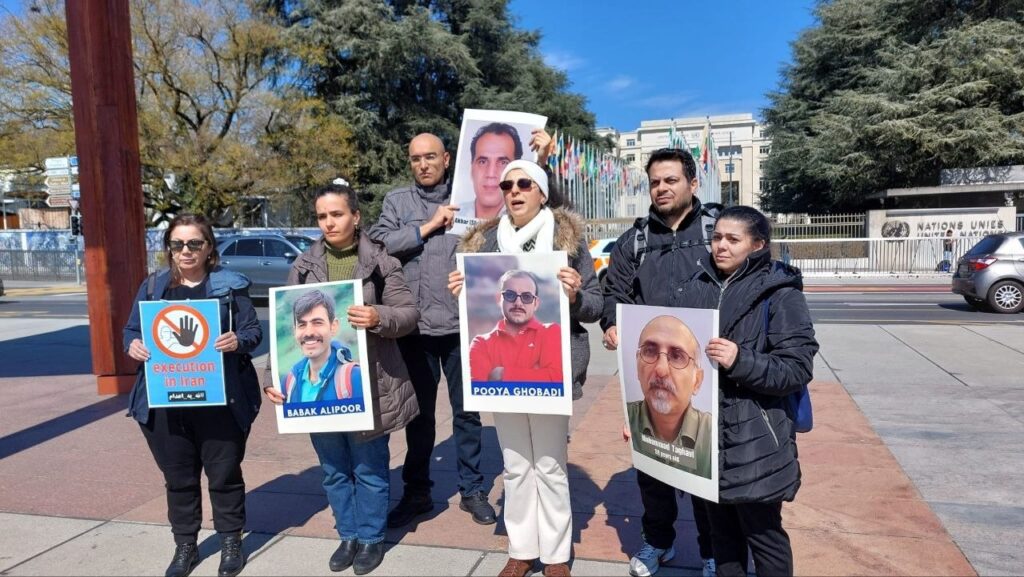
- 30 March 2026: Mohammad Taghavi and Akbar Daneshvarkar (PMOI members)
- 31 March 2026: Babak Alipour and Pouya Ghobadi (PMOI members)
- 2 April 2026: Amir Hossein Hatami (Anti-government protester)
- 4 April 2026: Abolhassan Montazar (Montazer) and Vahid Bani-Amerian (PMOI members)
- 5 April 2026: Shahin Vahedparast and Mohammad Amin Biglari (Anti-government protesters)
- 6 April 2026: Ali Fahim (Anti-government protester)
Four of the men were charged with “moharebeh” (waging war against God) and “corruption on earth” for allegedly attacking a classified military location, participating in the “destruction and arson of this sensitive site”, and “attempting to gain access to the armoury”.
The other six men were political prisoners charged with “membership in the PMOI”, “assembly and collusion to commit crimes against internal and external security”, “armed rebellion (baghi) against the Islamic government”, and “formation of a group to disrupt national security”.
In August 2025, the group of six political prisoners were transferred to Qezel Hesar Prison — a facility notorious for carrying out political executions — raising serious concerns about their imminent execution.
The prisoners were subjected to severe physical and psychological torture, including beatings, threats of summary execution, and prolonged solitary confinement.
Justice for the Victims of the 1988 Massacre in Iran (JVMI) had previously submitted case files for all six men to the UN Special Rapporteur on the situation of human rights in Iran on 10 August 2025.
Acting with the prisoners’ consent, JVMI also submitted detailed information on behalf of several of the prisoners to the UN Fact‑Finding Mission on Iran (FFMI) in October 2025, documenting the serious torture and abuses to which they were being subjected in detention. In each case, scanned copies of the prisoners’ handwritten testimonies were included.
On 5 September 2025, five UN Special Rapporteurs sent a joint letter to the Iranian authorities expressing “grave concern about the imminent risk of execution” of the six men, stating:
“The above mentioned six men have received death sentences for baghi (armed rebellion against the foundations of the Islamic Republic of Iran) based on their alleged connections with the People’s Mojahedin Organization of Iran (PMOI). They were arrested between 22 December 2023 and 23 February 2024 in various locations, including Tehran and the Chaldoran border. It is alleged that no arrest warrants were presented, and that excessive force and threats were used during arrest.”
“Moreover, we are seriously concerned at information indicating that the judicial proceedings in all six cases did not fulfil the requirements for due process and a fair trial under international human rights law, rendering such sentences unfair and the death penalty unlawful. Given the uncertainty surrounding any review or retrial, we are deeply concerned about the imminent risk of executions.”
A retrial for the six prisoners took place on 16 November 2025 at Branch 26 of the Tehran Revolutionary Court. Judge Afshari, who had handed down the initial sentences, presided over the retrial — a violation of the international standards of a fair trial. He ignored a demand by the prisoners’ lawyers that since all six cases were linked, they be heard together. Instead, he held separate sessions for each prisoner, with each hearing lasting just a few minutes.
On 7 December 2025, Branch 26 of the Tehran Revolutionary Court upheld all six death sentences.
The imposition of the death penalty following proceedings that fail to meet international fair‑trial standards violates Iran’s obligations under the International Covenant on Civil and Political Rights (ICCPR), including the right to life, the right to a fair trial, and the prohibition of torture and other ill‑treatment.
JVMI condemns the recent spate of political executions in Iran and warns that urgent international pressure is needed to prevent a repeat of the 1988 massacre.
JVMI repeats its request to the Office of the High Commissioner for Human Rights (OHCHR), the FFMI, the Special Rapporteur on Iran, and the international community to take immediate action to halt further executions and hold Iranian officials accountable.
***
Threats to repeat the 1988 Massacre
On 27 July 2025, political prisoners Behrouz Ehsani and Mehdi Hassani were executed in Ghezel Hesar, charged with membership in the People’s Mojahedin Organisation of Iran (PMOI or MEK), despite international appeals.
Those executions followed a 7 July 2025 editorial by Fars News Agency—affiliated with the Islamic Revolutionary Guard Corps (IRGC)—which described the 1988 mass executions as a “successful historical experience” and explicitly called for their repetition against current-day political opponents.
The editorial, entitled “Why the 1988 Executions Should Be Repeated”, not only justified and glorified crimes against humanity, but also issued what can only be interpreted as incitement to commit future atrocity crimes. It sought to normalise the extrajudicial killing of political opponents by framing them as threats to national security, aligning with a broader pattern of state-sponsored dehumanisation and criminalisation of dissent.
JVMI previously warned that the publication of such content by Iranian state media underscored the urgent risk of recurrence of mass atrocity crimes in Iran.
In his 2024 landmark report on atrocity crimes, the then-UN Special Rapporteur on Iran, Professor Javaid Rehman, concluded that the events of 1988 “amounted to the crimes against humanity of murder, extermination, persecution, and other inhumane acts”.
The report further noted that “there is considerable evidence that mass killings…were conducted with genocidal intent.” His report called for international accountability and noted the systematic impunity that has emboldened Iranian authorities to continue committing gross human rights violations, including the recent unlawful executions of protesters and prisoners of conscience.
Following major anti-government protests in late December 2025 and January 2026, Iranian authorities have threatened to execute anyone suspected of anti-government activity. As many as 50,000 people are believed to have been arrested for taking part in the protests.
Background to the 1988 Massacre
In 1988, the government of Iran massacred an estimated 30,000 political and ideological prisoners. The extrajudicial executions and enforced disappearances took place based on a fatwa by then-Supreme Leader Ayatollah Ruhollah Khomeini, targeting the PMOI. Three-member commissions known as ‘Death Commissions’ were formed across Iran, sending political prisoners who refused to abandon their beliefs to execution. Members of other leftist groups were also executed in a subsequent second wave. The victims were buried in secret mass graves. The perpetrators continue to enjoy impunity.
Contact
Justice for the Victims of the 1988 Massacre in Iran (JVMI)
Email: [email protected]
Website: www.iran1988.org