
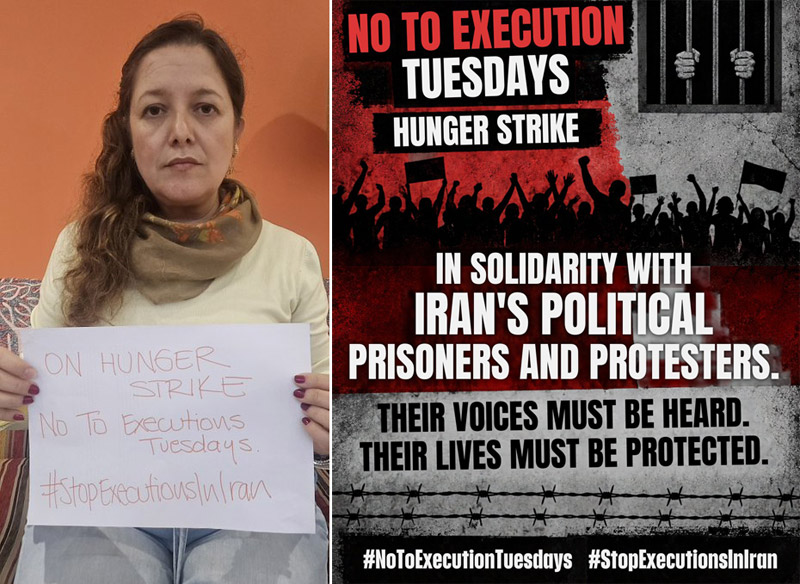
UN Special Rapporteur, Nobel Peace Prize Laureate, Former Parliamentarians and Human Rights Defenders Join “No to Execution Tuesdays” Campaign in Its 142nd Week
13 October 2026 — FOR IMMEDIATE RELEASE
An international wave of solidarity with political prisoners in Iran is gathering momentum today, Tuesday 13 October, as prominent human rights defenders, a United Nations Special Rapporteur, a Nobel Peace Prize laureate, former parliamentarians and Iranian expatriates take part in a 24-hour hunger strike against executions in Iran. They join political prisoners in Iran participating in the No To Execution Tuesdays hunger strike campaign.
Spanning four continents — Asia, Europe, North America, and South America — this international action marks a significant expansion of the No to Execution Tuesdays campaign, initiated by political prisoners inside Iran. The campaign has now reached its 142nd consecutive week, spanning to 66 prisons across the country and standing as the longest coordinated prison strike in modern Iranian history.
Among the most prominent participants is Gina Romero, the United Nations Special Rapporteur on the rights to freedom of peaceful assembly and of association, who publicly announced her decision to join the hunger strike on 13 October.
In a video message, Romero condemned the use of the death penalty against people exercising their fundamental rights, including freedom of assembly, association and expression. She highlighted the execution of political prisoners and protesters, serious violations of fair trial guarantees, torture and coerced confessions.
Referring to the courage of the striking prisoners, she declared:
“They are risking everything behind bars. I’m joining them from the outside. Will you join us?”
Her initiative has inspired a growing response from human rights defenders and prominent personalities internationally.
Jody Williams, the 1997 Nobel Peace Prize laureate, is among the international personalities joining the solidarity action.
In Italy, Elisabetta Zamparutti, Rita Bernardini and Sergio D’Elia, all former members of the Italian Parliament and leading figures in Hands Off Cain, the organisation campaigning worldwide against the death penalty, have announced that they are on hunger strike this Tuesday.
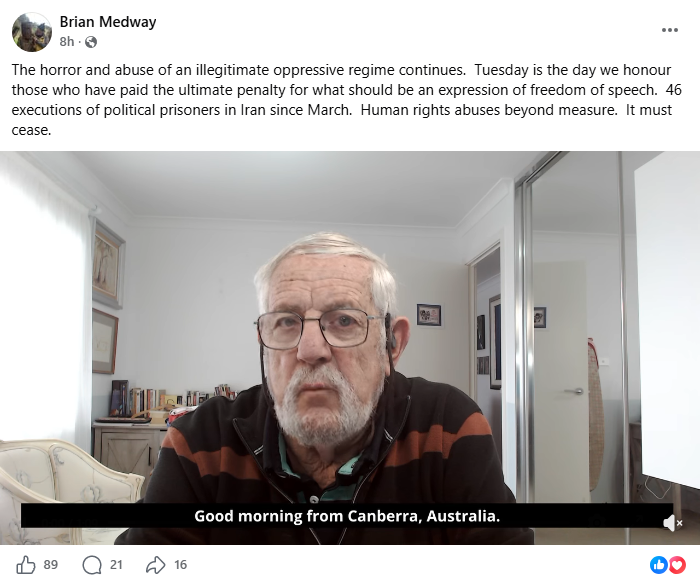
Other participants in the global solidarity hunger strike include Alastair Logan, a British human rights lawyer and Chair of the Solicitors International Human Rights Group, who publicly announced his decision to undertake a solidarity hunger strike, and Professor Pearl Eliadis, a Canadian human rights lawyer and professor at McGill University’s Max Bell School of Public Policy.
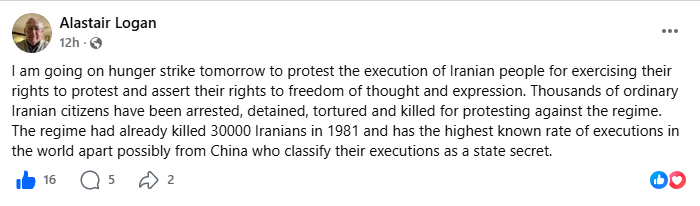
Numerous Iranian expatriates and human rights activists in different countries are also joining the initiative, extending the prisoners’ message beyond Iran’s borders. Many are publishing photos of themselves on hunger strike on social media with the hashtag: #NoToExecutionTuesdays.
A sharp rise in political executions in Iran
Already at least 46 political prisoners and protesters, including participants of the No To Execution Tuesdays campaign, have been executed since 19 March. They include nine members of the opposition People’s Mojahedin Organisation of Iran (PMOI or MEK) and 35 detained protesters. This represents the highest concentration of political executions in Iran since the 1988 massacre. The weekly campaign has pointed out that warning signs of another large-scale prison atrocity like the 1988 extrajudicial executions and enforced disappearances must not be ignored.
A movement born behind prison walls
The international solidarity action is rooted in one of the most persistent campaigns of peaceful resistance by political prisoners in Iran.
Launched on 30 January 2024 by prisoners in Ghezel Hesar Prison, the No to Execution Tuesdays campaign has grown into a coordinated weekly protest across Iran’s prison system.
Political prisoners affiliated with the PMOI, alongside detained protesters, human rights defenders, ethnic and religious minorities, and non-political death-row inmates, constitute the core organising backbone of the movement.
Every Tuesday, participating prisoners refuse food to protest the authorities’ increasing use of executions, particularly against political prisoners, detained protesters and individuals sentenced to death following grossly unfair trials.
While anchored by political prisoners, the campaign categorically defends all prisoners on death row. Strikers consistently demand the abolition of capital punishment across all classifications, including political detainees, protesters, trade unionists, ethnic minorities (notably Baluch and Kurdish populations), and impoverished common-law defendants convicted of drug-related offenses.
Despite threats, severe restrictions and the constant risk of reprisals, the campaign has continued without interruption for nearly three years.
On 6 October, during its 141st week, prisoners reported participation across 66 prisons, including Evin, Ghezel Hesar, Qarchak, Mashhad, Isfahan, Shiraz, Tabriz, Urmia and Zahedan.
In their latest statement, prisoners condemned the execution of at least 22 people during the preceding week, including five detained protesters, and urged the international community to stand with them against the use of capital punishment as an instrument of repression.
An urgent international response to escalating executions
The solidarity hunger strikes come amid growing international alarm over the escalating number of executions in Iran, particularly of individuals associated with popular protests and political dissent.
On 10 October, UN human rights experts called for an immediate halt to executions in Iran, drawing attention to the country’s contribution to the global surge in capital punishment.
The participation of international human rights figures in the hunger strike gives new visibility to prisoners who have continued their peaceful protest despite imprisonment, isolation and the threat of execution.
For the prisoners and their families, the message of this international action is clear: they are not alone, and their voices are being heard far beyond the walls of Iran’s prisons.
The growing solidarity movement calls on the United Nations, governments and international human rights institutions to press urgently for an immediate halt to executions in Iran and the cancellation of death sentences imposed following unfair trials, as well as independent monitoring of prisoners at risk and the protection of political prisoners and detained protesters.
As the No to Execution Tuesdays campaign enters its 142nd week, the determination of prisoners inside Iran is being answered by an expanding circle of supporters across the world, united around a fundamental principle: the right to life must be protected, and peaceful dissent must never be punished by death.
Justice for the Victims of the 1988 Massacre in Iran
13 October 2026