
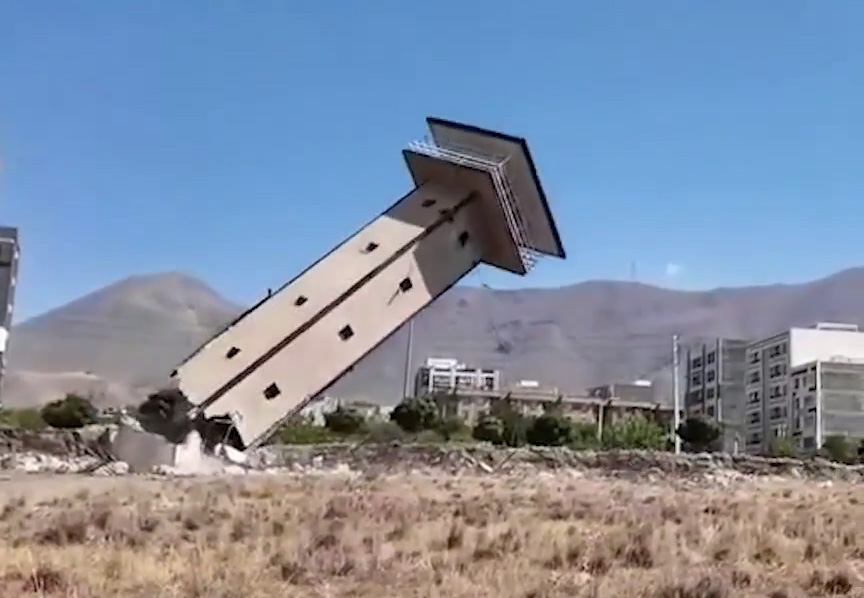
London, 5 October 2026 — Iranian authorities are demolishing Gohardasht Prison in Karaj, also known as Raja’i Shahr Prison, one of the principal sites of the 1988 massacre of political prisoners. State television broadcast the first phase of the demolition on 13 September 2026. On 4 October 2026, authorities tore down remaining watchtowers. The work is being carried out in the open, on the orders of the head of the judiciary, and is officially described as clearance for residential or commercial development.
Justice for the Victims of the 1988 Massacre in Iran (JVMI) condemns the demolition. Gohardasht is not a disused building. It is a crime scene. Its death corridor, the room used by the “Death Commission,” the execution hall and the torture chambers were mapped by survivors and placed on the judicial record in Sweden. Razing the site destroys physical evidence of crimes against humanity and obstructs any future investigation. Destroying evidence of an atrocity is a continuation of the crime.
Demolition ordered by the judiciary
On 13 September 2026, Alborz provincial television and the Islamic Revolutionary Guard Corps-linked Fars News Agency showed heavy machinery at the prison in the presence of Heydar Asiabi, head of the Prisons Organisation. Asiabi said: “Following the strict orders of the head of the judiciary, we were present in Karaj today so that all the surrounding walls of the prison would be demolished. This work has practically begun today, and within less than a month, all the walls will be destroyed to prepare the ground for the implementation of the development plan inside Karaj, whether for residential or commercial use.”
The prison was evacuated and closed in 2023. Rights groups warned at the time that closure was a prelude to demolition and to the loss of evidence. That warning has now been borne out. Footage from 4 October 2026 shows watchtowers being brought down as the clearance of the perimeter continued.
A principal site of the 1988 massacre
In late July 1988, then-Supreme Leader Ruhollah Khomeini issued a fatwa ordering the execution of political prisoners who remained “steadfast” in their beliefs. Three-member panels, later known as Death Commissions, put prisoners through hearings that often lasted only a few minutes. Those who refused to renounce their opposition were sent for execution. The killings continued into the autumn. Thousands of political prisoners were extrajudicially executed across Iran. The overwhelming majority were affiliated with the People’s Mojahedin Organisation of Iran (PMOI/MEK); prisoners from leftist groups were also killed.
Gohardasht was, after Evin, the main execution site for political prisoners held in the Tehran area. Survivors have described the same sequence: prisoners were blindfolded and lined up in a corridor — the “death corridor” — to await a hearing; those condemned were taken to an execution hall, the “Death Hall,” and hanged in groups. Isolation cells and torture chambers elsewhere in the complex were already notorious from the earlier years of the 1980s.
In the Swedish prosecution of former Gohardasht official Hamid Noury, survivors and the prosecution reconstructed that layout in testimony, sketches and a three-dimensional model. Prosecutors presented a list of 444 prisoners executed at Gohardasht. After a 92-session trial, the Stockholm District Court on 14 July 2022 convicted Noury of serious crimes against international law and murder and sentenced him to life imprisonment. The features now being reduced to rubble — the death corridor, the Death Commission room and the execution hall — are the same features that corroborated that judgment.
Architectural evidence of this kind is not interchangeable with testimony. The dimensions of a corridor, the relation of a hearing room to an execution hall, and traces in the fabric of the building can confirm or test survivor accounts. Prison registers, architectural plans, execution lists, photographs and personnel files associated with the site retain the same value. Once the ground is cleared for housing or shops, that evidence is gone.
Part of a sustained policy of erasure
The demolition follows a long campaign to remove the physical traces of the mass executions of the 1980s.
On 11 August 2025, authorities used bulldozers and heavy machinery, under armed guard, to flatten Section 41 of Behesht Zahra Cemetery in Tehran. That section held thousands of individual graves of political prisoners executed during the 1980s, with an estimated capacity of some 9,500 graves, many of them of PMOI members killed in 1981. Trees were cut, vegetation burned and the area sealed. Families had already been harassed, and gravestones defaced or obscured, for decades. Between 2005 and 2007 roughly 3,500 square metres of the same section were converted into a car park.
The same pattern has been documented at Khavaran Cemetery, the unmarked burial ground most closely associated with victims of the 1988 massacre, and at grave sites in Tabriz, Ahvaz, Mashhad and other cities. Gravestones have been smashed, inscriptions tarred over, and land repurposed so that families cannot gather or identify remains.
In his July 2024 report on atrocity crimes, Professor Javaid Rehman, then UN Special Rapporteur on the situation of human rights in Iran, characterised the 1988 executions as ongoing crimes against humanity and as genocide, and documented the destruction of grave sites at both Section 41 of Behesht Zahra and Khavaran. The move from burial grounds to the prison itself is an escalation. The authorities are no longer only concealing where the victims lie. They are dismantling the place where the victims were killed.
Destruction of evidence is part of the crime
Crimes against humanity are not exhausted by the original killings. They are perpetuated by denial, by the harassment of families, and by the destruction of evidence that would allow the truth to be established. International law treats the obligation to investigate and preserve evidence of such crimes as continuing. A state that bulldozes a documented execution site, and that has already levelled the cemeteries associated with it, is obstructing justice.
The Noury judgment showed that accountability is possible when evidence is preserved and survivors are heard. It also showed the limits of a single prosecution. Most of those who sat on the Death Commissions, and those who ordered the massacre, have never been tried. Physical evidence at Gohardasht still matters to any future case, whether before a national court exercising universal jurisdiction or before an international mechanism.
JVMI calls for an immediate halt and for preservation of the site
JVMI urges the Office of the High Commissioner for Human Rights, the UN Special Rapporteur on Iran, Dr Mai Sato, the Independent International Fact-Finding Mission on the Islamic Republic of Iran, and the Working Group on Enforced or Involuntary Disappearances to:
- demand an immediate halt to the demolition of Gohardasht Prison and to all further destruction of burial sites of political prisoners;
- seek urgent access so that independent forensic and architectural experts can document the site before it is cleared, including the death corridor, Death Commission room, execution hall and surviving watchtowers;
- call for the preservation of prison registers, architectural plans, execution records, photographs and personnel files associated with Gohardasht;
- treat the demolition as further evidence of ongoing crimes against humanity, of enforced disappearance, and of obstruction of justice;
- press for unrestricted access by families to remaining grave sites, including Behesht Zahra and Khavaran.
Member States of the United Nations should raise the destruction of Gohardasht in the current General Assembly session and in the assembly’s upcoming Third Committee resolution on the situation of human rights in Iran. A crime scene that has already supported one conviction for crimes against international law should not be allowed to disappear under a housing estate.
JVMI stands with the families of the victims. The memory of those executed at Gohardasht does not depend on the survival of the building. Accountability does.