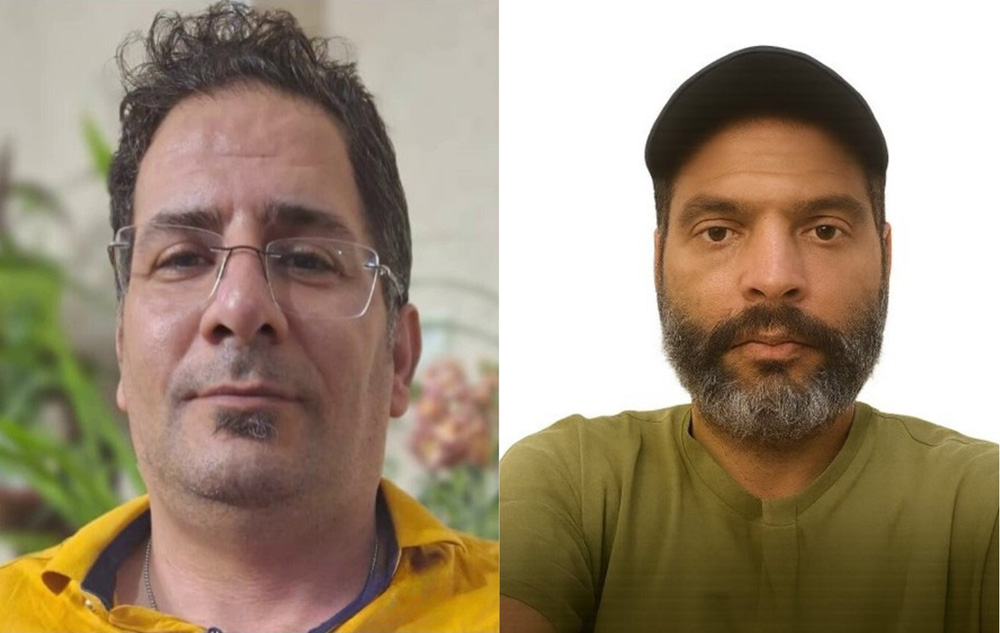
London, 20 April 2026: Iranian political prisoners Hamed Validi and Nima Shahi (Mohammad Masoum Shahi) were executed at dawn on Monday in Karaj Central Prison for membership in the opposition People’s Mojahedin Organisation of Iran (PMOI or MEK).
Validi, 45, a civil engineer, and Shahi, 38, a technician, were abruptly transferred from their ward Sunday evening, prompting concern that their execution was imminent.
They were arrested, along with their relatives, in Tehran on 13 May 2025 and subjected to interrogation and torture.
On 27 September 2025, the head of the judiciary in Alborz Province falsely accused them and two other political prisoners of spying for the Mossad in connection with the 12-day war. This was despite the fact that they had been arrested a month prior to the conflict. The PMOI has rejected the “false allegation” that either men spied for foreign states.
On 27 September 2025, Branch 3 of the Revolutionary Court of Karaj sentenced both men to death on charges including “moharebeh” (waging war on God), “membership in the PMOI”, “assembly and collusion to commit crimes against national security”, and “propaganda against the state”.
The judiciary’s news agency Mizan announced their execution this morning, adding that their sentence had been upheld by the Supreme Court.
Justice for the Victims of the 1988 Massacre in Iran (JVMI) had previously submitted their names and details to the United Nations Special Rapporteur on the situation of human rights in the Islamic Republic of Iran on 23 October 2025.
In recent weeks, at least 15 political prisoners and individuals arrested in relation to the January 2026 protests, including six other PMOI members, have been executed in Iran.
Threats to repeat the 1988 Massacre
On 27 July 2025, political prisoners Behrouz Ehsani and Mehdi Hassani were executed in Ghezel Hesar, charged with membership in PMOI, despite international appeals.
Those executions followed a 7 July 2025 editorial by Fars News Agency—affiliated with the Islamic Revolutionary Guard Corps (IRGC)—which described the 1988 mass executions as a “successful historical experience” and explicitly called for their repetition against current-day political opponents.
The editorial, entitled “Why the 1988 Executions Should Be Repeated”, not only justified and glorified crimes against humanity, but also issued what can only be interpreted as incitement to commit future atrocity crimes. It sought to normalise the extrajudicial killing of political opponents by framing them as threats to national security, aligning with a broader pattern of state-sponsored dehumanisation and criminalisation of dissent.
In his 2024 landmark report on atrocity crimes, the then-UN Special Rapporteur on Iran, Professor Javaid Rehman, concluded that the events of 1988 “amounted to the crimes against humanity of murder, extermination, persecution, and other inhumane acts”.
The report further noted that “there is considerable evidence that mass killings…were conducted with genocidal intent.” His report called for international accountability and noted the systematic impunity that has emboldened Iranian authorities to continue committing gross human rights violations, including the recent unlawful executions of protesters and prisoners of conscience.
Following major anti-government protests in late December 2025 and January 2026, Iranian authorities have threatened to execute anyone suspected of anti-government activity. As many as 50,000 people are believed to have been arrested for taking part in the protests.
JVMI condemns the systematic political executions in Iran and warns that urgent international pressure is needed to prevent a repeat of the 1988 massacre.
JVMI repeats its request to the Office of the High Commissioner for Human Rights (OHCHR), the Fact‑Finding Mission on Iran (FFMI), the Special Rapporteur on Iran, and the international community to take immediate action to halt further executions and hold Iranian officials accountable.