A Steadfast Champion of Human Rights and Justice for the Victims of the 1988 Massacre in Iran
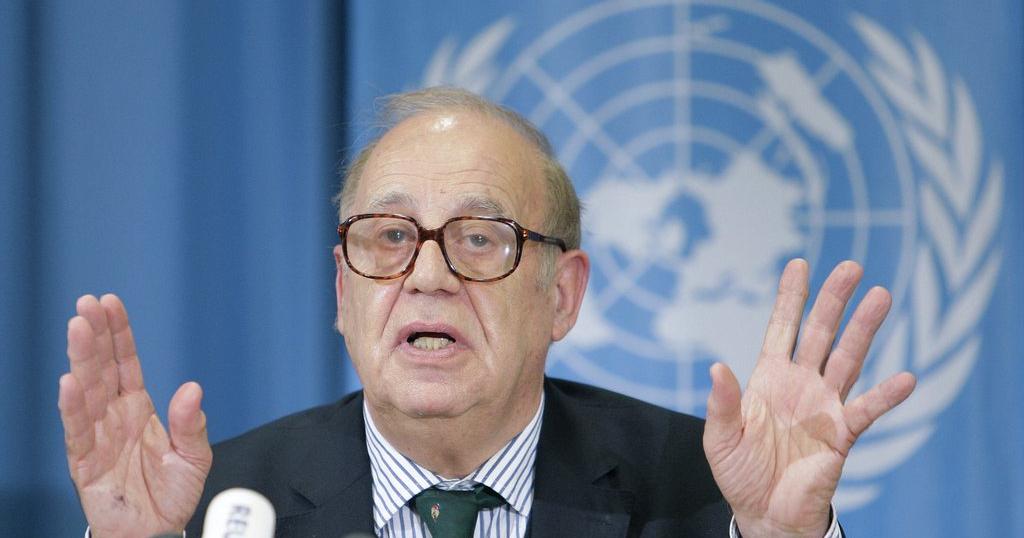
Justice for the Victims of the 1988 Massacre in Iran (JVMI) expresses its profound sorrow and pays a solemn tribute to Professor Jean Ziegler, who passed away on 10 June 2026 at the age of 92.
Professor Ziegler was an esteemed jurist, professor, thinker, author, and long-serving UN expert. He possessed a rare and formidable intellectual brilliance: the ability to seamlessly connect historical facts with contemporary political realities to derive clear, unassailable legal conclusions. Throughout his illustrious career, he dedicated himself to exposing grave and massive human rights violations across the globe.
Yet, it is his towering contribution to the cause of justice in Iran that will forever remain etched in our hearts. Professor Ziegler was one of the key architects in legally defining the 1988 mass executions of political prisoners in Iran as a crime against humanity.
A Promise Kept: Taking Up the Torch
His commitment to the Iranian people began through a long-standing friendship with Dr Kazem Rajavi, the former representative of the National Council of Resistance of Iran (NCRI) to the United Nations. From the tragic summer of 1988 onwards, Professor Ziegler mobilised tirelessly to denounce the horrific slaughter taking place inside Iran’s prisons.
When Dr Rajavi was assassinated in April 1990 by Tehran-backed terrorists travelling on diplomatic passports, Professor Ziegler did not falter. Instead, he took up his fallen friend’s torch, stepping forward to defend political prisoners and the young dissidents enduring torture and execution under clerical rule.
Professor Ziegler often said that Iran’s modern popular uprisings were driven not just by immediate socio-economic grievances, but by deep-seated roots watered by the “sacrifices” of the People’s Mojahedin Organisation of Iran (PMOI/MEK) activists massacred in the 1980s.
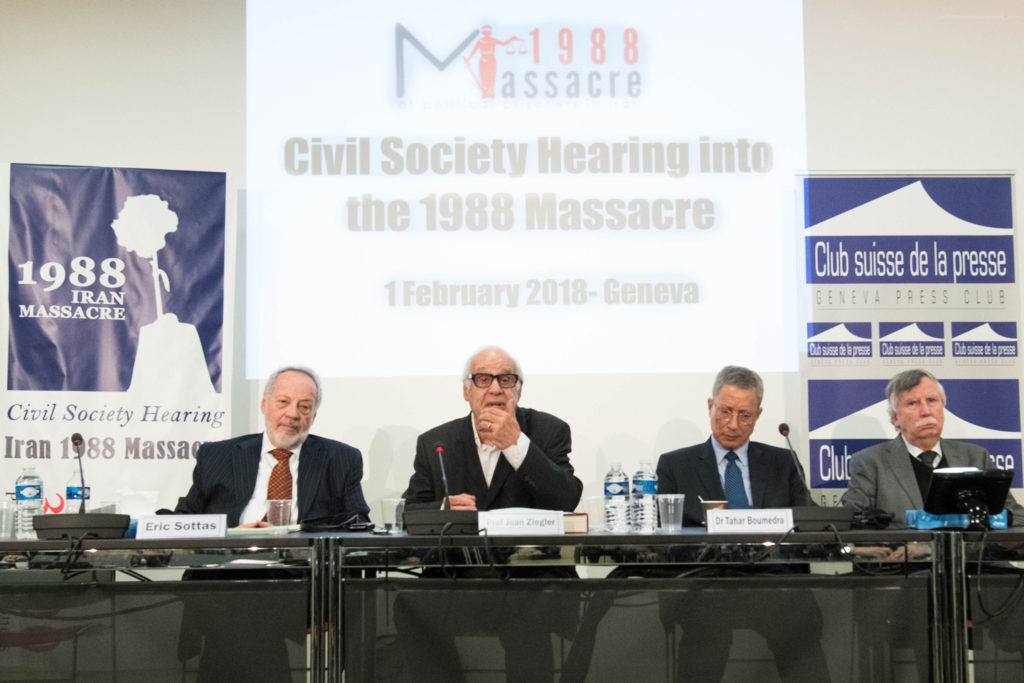
Speaking in Geneva on 1 February 2018 at a civil society hearing organised by the JVMI, he powerfully articulated this connection:
“The Iranian population has risen up again, a new generation. These young people have demonstrated in over 30 towns, laying their lives on the line… They know that they are risking their lives, according to the Western press, to protest at high prices, at economic misery, at the mullahs’ corruption. This is certainly true, but in fact, at its deepest, the fire that animates them is the fire of the martyrs of 1988. They are demanding freedom, democracy, respect for human rights, and they are certainly fed by the heroic example of the martyrs of 1988…
Jean Jaurès said: ‘The road is lined with corpses, but it leads to justice.’ So what’s happening today in Iran reveals a tremendous hope, because… the legacy, the example, the martyrdom, the sacrifice of the heroes and heroines of 1988 is being reincarnated, reincarnated in the young generation which is rising up today for the same values: democracy, independence, freedom in Iran.”
Exposing the Mechanics of Tyranny
With his profound understanding of both UN mechanisms and the internal workings of the theocratic system governing Iran, Professor Ziegler was uniquely equipped to guide non-governmental organisations (NGOs) on the path to accountability. He frequently emphasised that the perpetrators of the 1988 mass murders could be identified and held to account, highlighting the role of the infamous “Death Commissions” established by Khomeini’s fatwa:
“First of all, there are those members of those famous Death Commissions that Khomeini set up: a prosecutor, a religious judge and a representative of the Intelligence Ministry. In every village, in every province, in every town there was a Death Commission… Khomeini, in the fatwa which is here, and which is also very detailed, set up these Death Committees. He said: If two out of the three agree to execution – execute them. There was no right to defence, no right to a lawyer, no right to be heard… So those members of the Commissions can be identified. If they are alive, the members of these Commissions can be easily identified.”
This insight also drove his fierce advocacy for the protection of thousands of Iranian dissidents who were trapped in Camp Ashraf, Iraq, under continuous attack at the behest of the Iranian authorities. He viewed them not only as the true heirs to the 1988 martyrs, but as vital living witnesses to the massacre. He knew that the Iranian authorities sought to eliminate them primarily to erase the evidence of their ultimate crime.
A Legacy of Victory
For over thirty years, Professor Ziegler carried this plea through every corridor of the United Nations. He used his personal relationships with UN Secretaries-General, High Commissioners for Human Rights, diplomats, and journalists to ensure the world could not look away.
His perseverance was vindicated when the arc of time finally bent toward justice, culminating in the historic July 2024 recognition of the 1988 massacre as a genocide and a crime against humanity.
JVMI pays its most solemn and heartfelt tribute to Professor Jean Ziegler. We honour his immense service to a humanity so often broken by oppressors. His courage, clarity, and unwavering solidarity will continue to inspire us until the day his vision of a free and democratic Iran is fully realised.